Why Medical Paperwork Standardization Fails in Medical Practices
Why templates fail in medical paperwork: each case requires judgment based on patient details, clinical context, and payer rules.
Article· 5 min read Joseph Pipia
Medical practices process large volumes of paperwork every day: prior authorization requests, medical necessity documentation, insurance paperwork, appeal packets, surgical clearances, payer-specific forms, and supporting documentation that must be sent to payers, hospitals, surgery centers, and other providers.
Many practices try to solve this with standardized templates.
Templates help. But they do not solve the real problem.
The hard part is not formatting the document. The hard part is knowing what each specific case requires.
Every case is a unique mix of patient details, clinical context, payer rules, missing information, timing, and staff judgment. That is why so much medical paperwork is still done manually by the staff.
Their experience is the real system.
They know what the payer usually asks for. They know which clinical notes matter. They know what information is missing. They know how to prepare the paperwork so it has a better chance of being accepted.
But most of that knowledge is trapped in their heads.
The problem is not templates. The problem is judgment.
When people talk about automating medical practice paperwork with pre-built templates, they often assume the problem is the document itself.
They think the practice needs a better form, a cleaner template, or a more consistent packet.
But the document is only the final output.
Before the paperwork can be generated, someone has to answer harder questions:
What does this specific patient need?
Which payer rule applies?
Which clinical information supports the request?
Has this patient tried the required treatment first?
Is this for a visit, surgery, procedure, medication, referral, or appeal?
What should be sent, and to whom?
This is why automation fails.
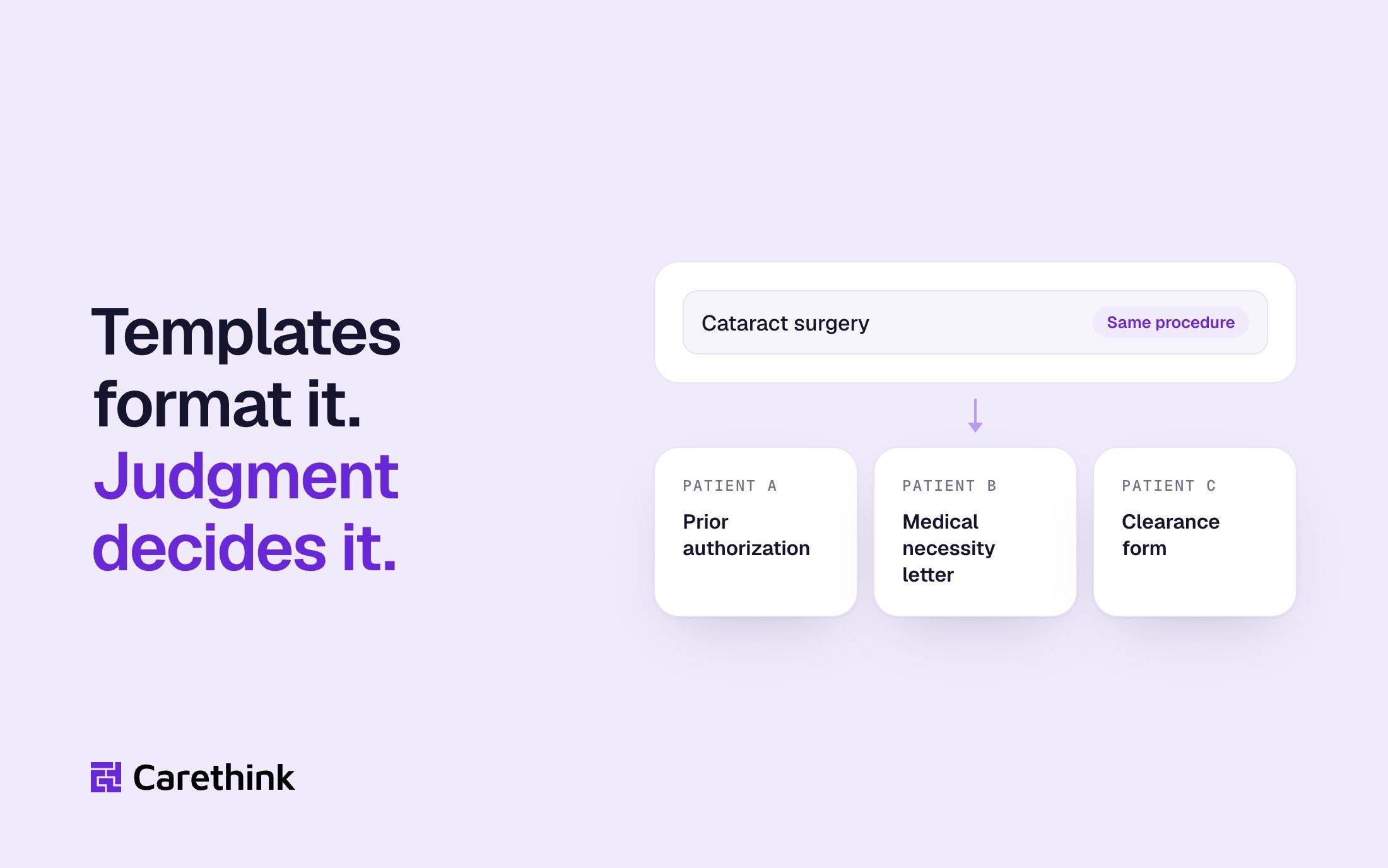
Templates can standardize the format of the output. They cannot capture all the judgment required to generate the right paperwork for each case.
The size of the problem is large. The American Medical Association’s 2025 prior authorization survey found that practices complete an average of 40 prior authorizations per physician per week, and physicians and staff spend 13 hours per week on the process. The same survey found that 40% of physicians have staff who work exclusively on prior authorization. (American Medical Association)
1. The same procedure can require different paperwork
A practice may perform the same procedure many times, but the paperwork around that procedure can change from case to case.
One patient may need medical necessity documentation. Another may need proof of prior treatment. Another may need records from a referring provider. Another may need a payer-specific form, a referral, an authorization, or additional clinical notes.
The procedure may be the same.
The paperwork is not.
That is why a single standardized template often breaks down. It can define the structure of the document, but it cannot decide what this particular case needs.
2. Payer rules create constant variation
Payer rules are one of the biggest reasons practice-generated paperwork is hard to standardize.
Different payers may require different forms, different supporting documentation, different submission channels, and different proof of medical necessity. Even the same payer may have different requirements depending on the patient’s plan, diagnosis, procedure, medication, or site of service.
CMS is pushing payers toward better prior authorization data exchange. Its Interoperability and Prior Authorization Final Rule requires impacted payers to implement a Prior Authorization API that can identify documentation requirements and support prior authorization requests and responses, with major API requirements beginning in 2027. (Centers for Medicare & Medicaid Services)
That is important progress.
But it also confirms the underlying problem: the paperwork depends on knowing the documentation requirements for the specific case.
3. Clinical context changes what needs to be generated
Medical paperwork is not just administrative.
It depends on clinical context.
For example, a medical necessity letter or prior authorization packet may need to show diagnosis, severity, failed prior treatments, test results, imaging, medications, symptoms, physician notes, or the reason a procedure is needed now.
A template can provide a structure.
But someone still has to know which clinical facts matter.
That is why experienced staff are so valuable. They know how to look at the chart and understand what information will support the request.
4. Standard templates do not learn from prior cases
Every time staff generate paperwork, they learn something.
They learn what worked.
They learn what was rejected.
They learn what the payer asked for next.
They learn what documentation helped.
But most practices do not capture that learning in a reusable way.
The next staff member starts again from memory, old examples, coworker advice, or trial and error.
This is one of the biggest weaknesses of template-based standardization.
A template can be copied.
Judgment usually cannot.
5. Paperwork is often created from scattered information
The information needed to generate paperwork may be spread across many places:
The EHR, faxed records, referral documents, insurance cards, prior notes, test results, scanned PDFs, portal messages, phone notes, voicemails, outside provider records.
This matters because generated paperwork is only as good as the information behind it.
If the supporting information is scattered, incomplete, or hard to find, the template will not solve the problem.
6. Payer pushback changes the paperwork after it is sent
The first version of the paperwork is often not the end of the process.
The payer may ask for more information.
The request may be denied.
The denial may require an appeal.
The appeal may need stronger medical necessity documentation.
The payer may ask for records that were not included the first time.
CMS now requires impacted payers to provide specific reasons for denied prior authorization decisions beginning in 2026, regardless of whether the decision is communicated through portal, fax, email, mail, or phone. (Centers for Medicare & Medicaid Services)
That is helpful, but it also shows why paperwork generation is not a one-time template task.
The paperwork changes as the case develops.
7. The real work is deciding what should be generated
The deepest reason standardization fails is simple:
The practice is not just producing documents.
The practice is making case-specific decisions.
For every case, staff must decide:
- What paperwork is required?
- What evidence should be included?
- What clinical information supports the request?
- Which payer rule applies?
- What should be generated first?
- What should be sent if the payer pushes back?
- What needs human review before it goes out?
- This is why templates alone are not enough.
Where AI can help
AI is helping practices apply case-specific judgment.
AI can help read incoming documents, understand what type of case it is, find relevant information, suggest what paperwork needs to be generated, and draft the right output for staff to review.
Over time, AI can also help capture the operating knowledge that experienced staff use every day.
That is the real opportunity.
Not replacing staff judgment.
Capturing it, organizing it, and making it easier to apply across the practice.
Final takeaway
Medical paperwork cannot be fully standardized because every case is different.
Each document a practice generates depends on a unique mix of patient details, clinical context, and the payer rules.
Templates can standardize the output.
But they do not capture the knowledge required to decide what the output should be.
That is why so much medical paperwork is still done manually by the staff.
And that is why the future of medical paperwork is not more rigid templates.
The future is context-aware paperwork generation: software that understands each case, learns from experienced staff, and helps practices generate the right paperwork faster, with fewer delays and fewer manual steps.
About the author

Joseph Pipia is a healthcare technology entrepreneur and product builder. He has built and scaled health tech products used by large hospitals and ambulatory centers, supporting care for millions of patients. He earned his MBA from MIT Sloan School of Management.
Joseph Pipia on LinkedIn