Cloud Fax vs AI Fax in Healthcare: The Operational Difference
Learn how cloud fax and AI fax differ in healthcare, from document storage and routing to data extraction, EHR integration, security, and staff workload.
Article· 4 min read Joseph Pipia
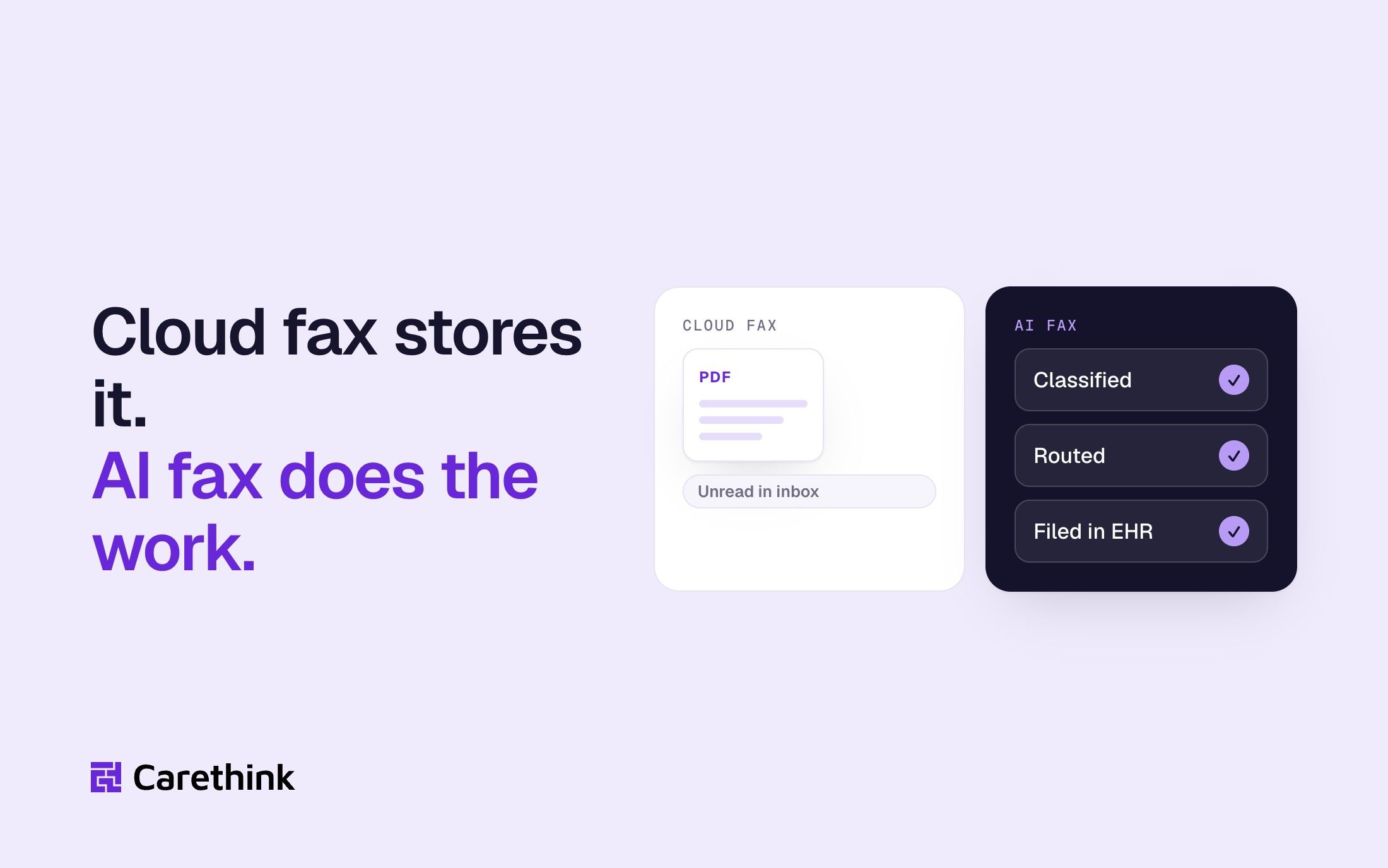
Cloud fax and AI fax solve different operational problems. Cloud fax digitizes how documents are sent, received, and stored. AI fax eliminates the remaining manual work associated with fax processing by classifying documents, extracting key data, routing them to the right team, and connecting them to the correct patient records.
For healthcare organizations, that difference matters because much of the administrative work begins after a fax arrives.
What cloud fax improves
Cloud fax, also called online fax, electronic fax, e-fax, or internet fax, replaces the traditional fax machine and dedicated analog line. Staff can send and receive faxes through an online portal, application, or email. Incoming documents are usually delivered as PDFs and stored electronically in the cloud storage.
This provides meaningful benefits:
- Documents can be accessed from multiple locations.
- Large documents can be transmitted more reliably without overwhelming a physical fax line.
- Multiple faxes can be sent and received simultaneously, preventing one large transmission from blocking other incoming or outgoing faxes.
- Sent and received faxes can be archived and searched.
- Multiple employees can access a shared fax account.
- Organizations no longer need to manage paper, toner, or physical fax machines.
Cloud fax is therefore a clear improvement over paper-based faxing.
Why cloud fax can leave the workflow unchanged
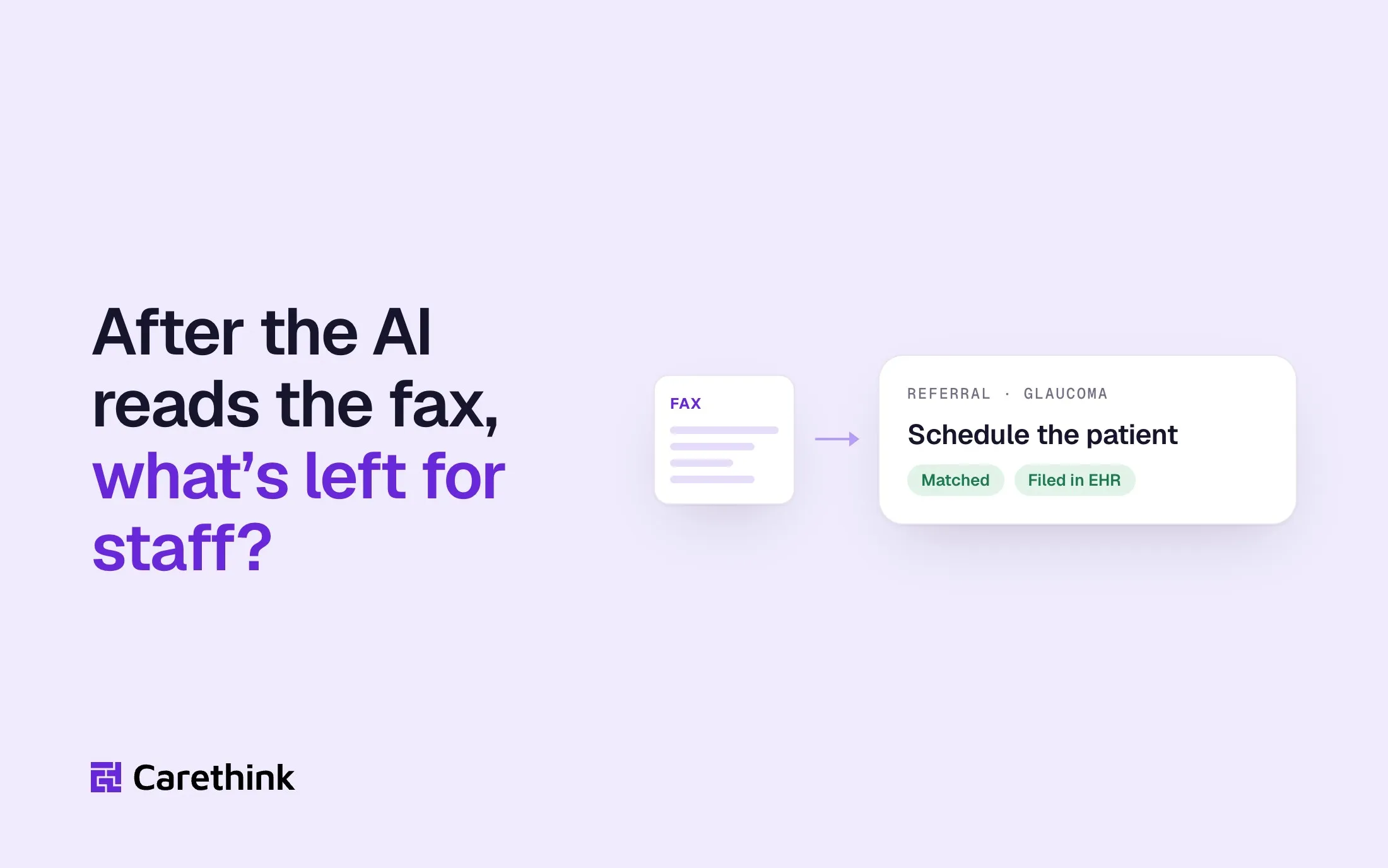
A digital fax is still usually an unstructured document. When it arrives in a shared inbox, someone needs to open it, determine what it is, assess whether it is urgent, and forward it to the correct person or department.
Staff then need to identify the patient, enter information into another system, upload the document to the EHR, select the appropriate folder, and create a task for follow-up.
This is effectively the same sorting and distribution work that occurred with paper faxes, now performed through screens and email inboxes.
What AI fax adds
AI fax applies document intelligence to the inbound fax workflow. Depending on the system and its integrations, it can:
- Classify documents into categories: referrals, lab results, medication requests, prior authorization responses, medical records, or other categories.
- Extract fields such as patient name, date of birth, insurance information, referring provider, authorization number, effective dates, or requested service.
- Route documents to the appropriate team, employee, or operational queue.
- Match documents to existing patients.
- Upload the fax to the correct EHR chart and document category.
The operational benefit goes beyond reducing staff time. We have seen documents delayed or effectively lost during manual distribution because a fax was forwarded to the wrong person, placed in the wrong folder, or left in an inbox without a clear owner. These problems occur with both paper-based faxing and standard online fax services when routing still depends on staff.
AI fax substantially reduces this risk by applying consistent classification and routing rules as soon as a document arrives. Faxes reach the appropriate queue with the relevant information already extracted, reducing misplaced documents, unclear ownership, and delays in patient care.
Instead of repeatedly checking a general inbox, each team can work from a queue containing the documents relevant to its responsibilities. Staff attention can be directed toward incomplete documents, uncertain matches, unusual cases, and other exceptions.
Carethink’s AI fax workflow, for example, is designed to classify inbound documents, extract configured fields with high precision, match documents to patients, and file them in the appropriate EHR location with the context needed for further processing.
How to evaluate cloud fax versus AI fax
The right choice depends on the operational goal. If the priority is eliminating machines and providing online access, cloud fax may be sufficient. If the priority is reducing manual sorting, data entry, routing, and EHR filing, the organization needs an AI processing and workflow layer.
Before selecting a platform, evaluate:
- Document classification and urgency detection
- Field-level extraction accuracy
- Patient-matching controls
- EHR and practice-management integrations
- Exception queues and human review
- Audit trails, user permissions, and reporting
- Business associate agreements and security safeguards
The operational difference should ultimately appear in measurable outcomes: fewer staff touches per fax, faster routing, less rekeying, fewer filing errors, and more documents reaching the correct workflow without manual intervention.
FAQs
Is AI fax the same as cloud fax?
No. Cloud fax sends, receives, and stores documents electronically. AI fax adds classification, data extraction, routing, patient matching, and workflow automation.
Can AI fax upload documents directly into an EHR?
Some platforms can match a fax to a patient and file it in the correct EHR chart or folder. Capabilities depend on the vendor, EHR integration, and available patient identifiers.
Is cloud fax automatically HIPAA compliant?
No technology is automatically compliant in every implementation. Healthcare organizations should review safeguards, access controls, audit capabilities, data handling, vendor responsibilities, and the availability of a business associate agreement.
Sources used
About the author

Joseph Pipia is a healthcare technology entrepreneur and product builder. He has built and scaled health tech products used by large hospitals and ambulatory centers, supporting care for millions of patients. He earned his MBA from MIT Sloan School of Management.
Joseph Pipia on LinkedIn