How Medical Practices Should Schedule Referrals
Learn how to optimize referral scheduling by considering medical urgency, appointment deadlines, provider capacity, payer requirements, and patient context.
Article· 4 min read Joseph Pipia
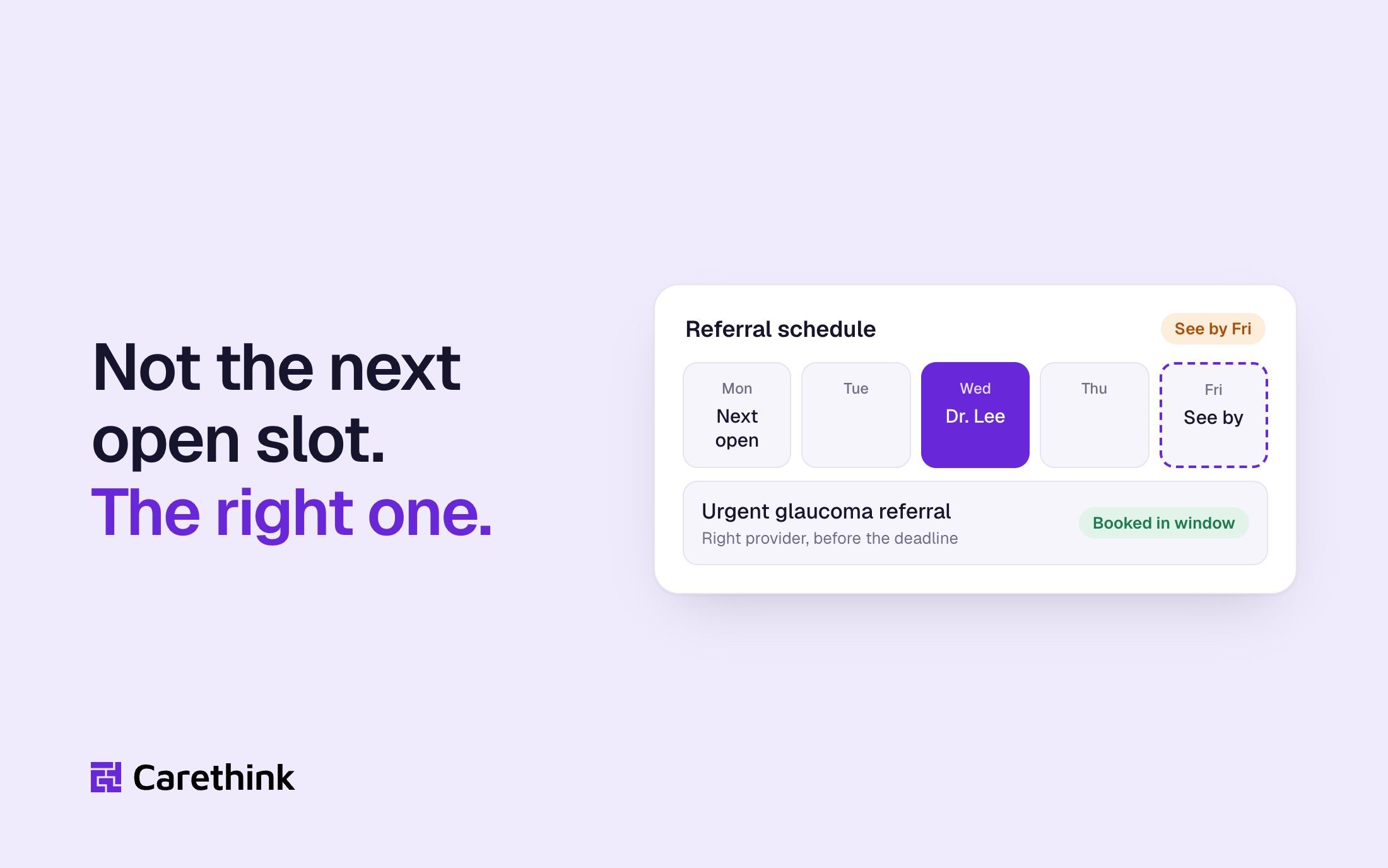
Effective referral scheduling means finding the right appointment slot. The next open slot is only one input. Medical urgency, provider suitability and capacity, payer and other contractual commitments, and the patient’s circumstances together determine the referral’s operational priority and the best scheduling action. Practices that combine these factors can improve timely access without relying on staff memory, spreadsheets, or improvised exceptions.
Begin with medical urgency
Every referral should first be classified by reason for visit and medical urgency. Medical urgency is a clinical determination of how quickly the patient should be seen. A patient with symptoms suggesting an immediate risk cannot enter the same queue or timeline as a routine evaluation. The practice should use triage protocols, with clinical review for high-risk, incomplete, or uncertain cases.
Medical urgency should remain distinct from the other factors used to determine operational priority. Provider capacity, contractual commitments, and patient circumstances may change which action the practice takes next, but they do not change the medical urgency of the patient’s condition.
Assign a latest acceptable appointment date
Labels such as “urgent” and “routine” are difficult to manage unless they produce a deadline. Each accepted referral should have a latest acceptable appointment date: the last date on which the patient can be scheduled while still meeting the practice’s clinical and operational requirements.
That date should reflect the earliest binding constraint, including:
- The clinically appropriate timeframe
- A specific request from the referring clinician
- A payer, authorization, or co-management requirement
- A practice-approved scheduling protocol
The deadline should remain visible and be updated when new information arrives. Provider capacity does not change the patient’s deadline. If no suitable slot exists before it, the case needs escalation.
Match the referral to the right capacity
Referral scheduling should evaluate capacity by provider, subspecialty, location, visit type, and appointment length. Booking the first available clinician is ineffective if that clinician is not appropriate for the patient’s condition or if the visit requires equipment available only at another location.
A National Academies report identifies ongoing supply-and-demand measurement as a basic principle of timely access. Practices should therefore measure referral demand by clinical category and compare it with usable capacity, not just total open slots. The American Medical Association also treats the ability to see referred patients within the right timeframe as a core part of referral service.
When appropriate capacity is unavailable before the deadline, the workflow should offer a defined escalation path. Options may include a protected priority slot, another qualified provider or location, clinician-to-clinician review, or safe redirection to another organization. The patient and referrer should not be left without an answer.
Apply payer and contractual requirements consistently
Some referrals carry payer, authorization, co-management, or other contractual requirements that affect where and when the patient can be scheduled. These may determine whether a provider or location is eligible, whether authorization must be completed first, or whether the visit must occur within a defined window.
The practice should capture these requirements as patient-specific scheduling constraints and apply the same rules consistently whenever those requirements apply. AHRQ recommends systematic referral agreements that clarify required information, responsibilities, and communication across the referral process.
These constraints contribute to operational priority because they determine which appointments are valid and when the next action must occur. They should be applied according to documented rules, not informal staff judgment.
Use patient context to select a feasible appointment
A technically available slot is not useful if the patient cannot attend it. Scheduling should account for work and caregiver obligations, transportation, language and interpreter needs, mobility, preferred location, communication method, and insurance or authorization readiness.
Patient context should help the practice choose the most feasible slot within the appropriate window. It should not be used to downgrade urgency. The National Academies recommends involving patients in defining preferences and improving communication about wait times and future care needs.
Turn the decision into a managed workflow
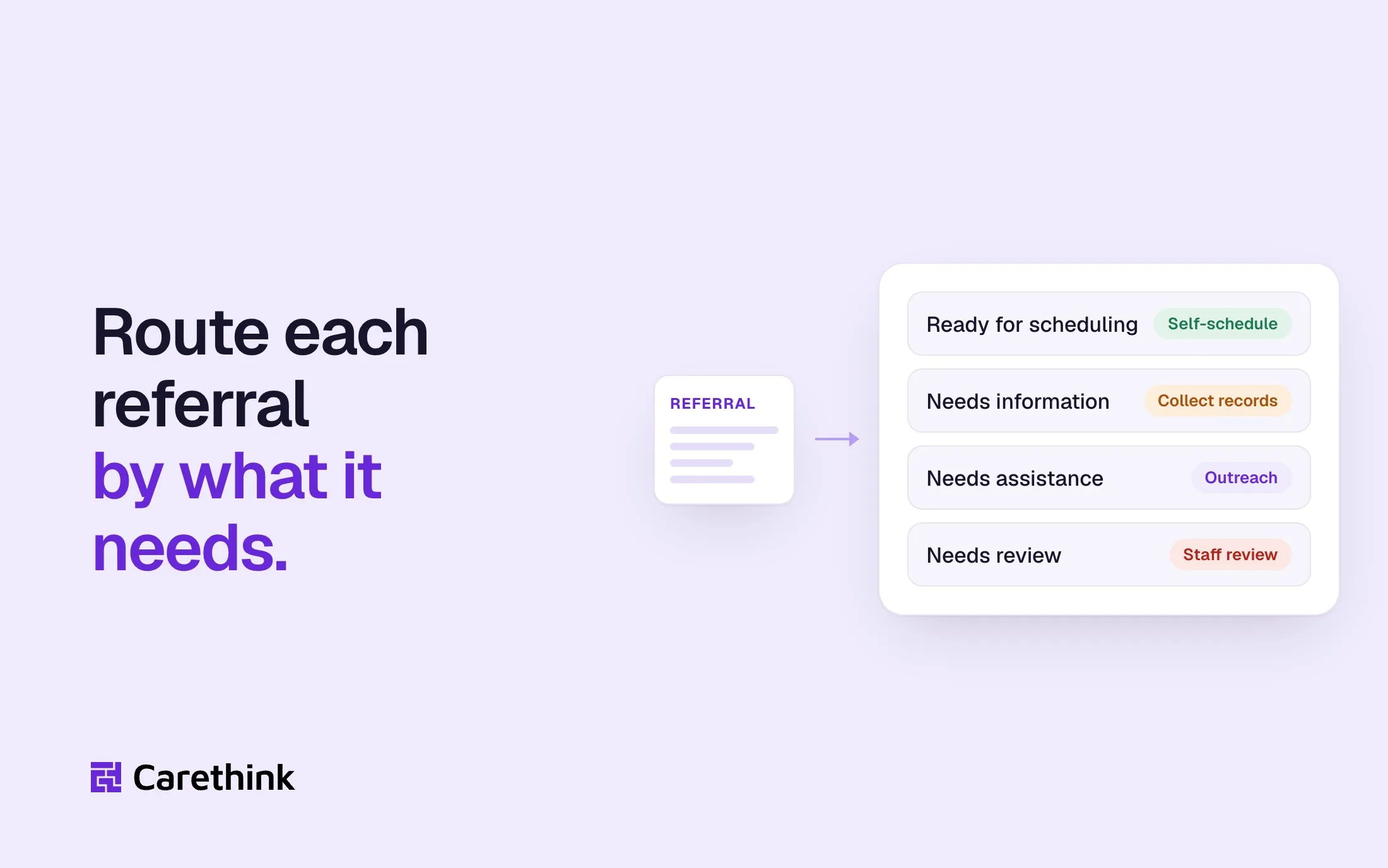
Once the constraints are known, routine referrals can move to guided self-scheduling. Priority, complex, or uncertain cases should go to staff with the referral summary, deadline, suitable providers, and recommended next action already visible.
Management should track the percentage of referrals scheduled before their deadline, time from receipt to review, time to first contact, completed-visit conversion, and exceptions by reason. AHRQ’s closed-loop research emphasizes tracking referrals within clinically and patient-important timeframes.
Carethink referral automation supports this approach by capturing incoming referrals, identifying the reason for visit, highlighting urgency, establishing appointment windows, organizing follow-up, and tracking referrals through scheduling and completion. The practical goal is straightforward: give every appropriate referral a timely, feasible path to the right provider.
FAQs
What is the latest acceptable appointment date?
It is the last date a patient should be seen while still meeting the applicable clinical, referral, payer, authorization, and practice requirements.
How do payer and contractual requirements affect referral scheduling?
They can determine which providers or locations are eligible, whether authorization is required, and whether the visit must occur within a defined window. Practices should apply these requirements consistently to every patient for whom they apply.
What should happen when no appropriate slot is available before the deadline?
The referral should be escalated through a defined path, such as a protected slot, alternate qualified provider or location, clinical review, or safe redirection with updates to the patient and referrer.
Sources used
- Carethink Referral Automation
- Referral Management Software in 2026, Carethink
- Strategy 6E: Rapid Referral Programs, AHRQ
- A Guide to Maximizing Physician Referral Strategies, AMA
- Transforming Health Care Scheduling and Access, National Academies
- Building from Best Practices, National Academies
- R18 Closed Loop Diagnostics, AHRQ
About the author

Joseph Pipia is a healthcare technology entrepreneur and product builder. He has built and scaled health tech products used by large hospitals and ambulatory centers, supporting care for millions of patients. He earned his MBA from MIT Sloan School of Management.
Joseph Pipia on LinkedIn