What We Learned About Voicemail Management Inside an Ophthalmology Practice
What we learned inside an ophthalmology practice—and how centralizing voicemail improved visibility, staff efficiency, prioritization, and patient follow-up.
Article· 4 min read Joseph Pipia
We did not enter an ophthalmology practice intending to redesign its voicemail process. We discovered the problem while sitting alongside the administrative team during a product implementation. A physician approached a patient coordinator and asked why a patient had left several voicemails without receiving a response.
That conversation led us to examine how voicemail management actually worked. What we found was a largely invisible process. By making it visible, the practice improved processing speed, team coordination, accountability, and patient follow-up.
The discovery started with one patient complaint
Incoming calls rang approximately 10 times before reaching voicemail. The practice had chosen this setting to give employees more opportunities to answer. However, it had no way to determine whether the additional ringing increased the answer rate or caused patients to abandon their calls.
When a call reached voicemail, the message remained on an individual employee’s phone. Scheduling questions might go to one person, surgical questions to another, and clinical messages to a physician assistant. Refill requests, billing questions, and other patient needs were distributed across separate voicemail boxes.
Staff members were processing these messages, but the workflow depended heavily on individuals. Leaders could not easily answer basic operational questions:
- How many voicemails did the practice receive?
- Which messages were urgent?
- Had someone reviewed and returned each message?
- How long did resolution take?
- Who was responsible for the next step?
A voicemail could be heard without being resolved. An employee could attempt a callback without other team members knowing. The practice had no shared record of the work and no reliable way to know whether every patient received a response.
Making the voicemail process visible
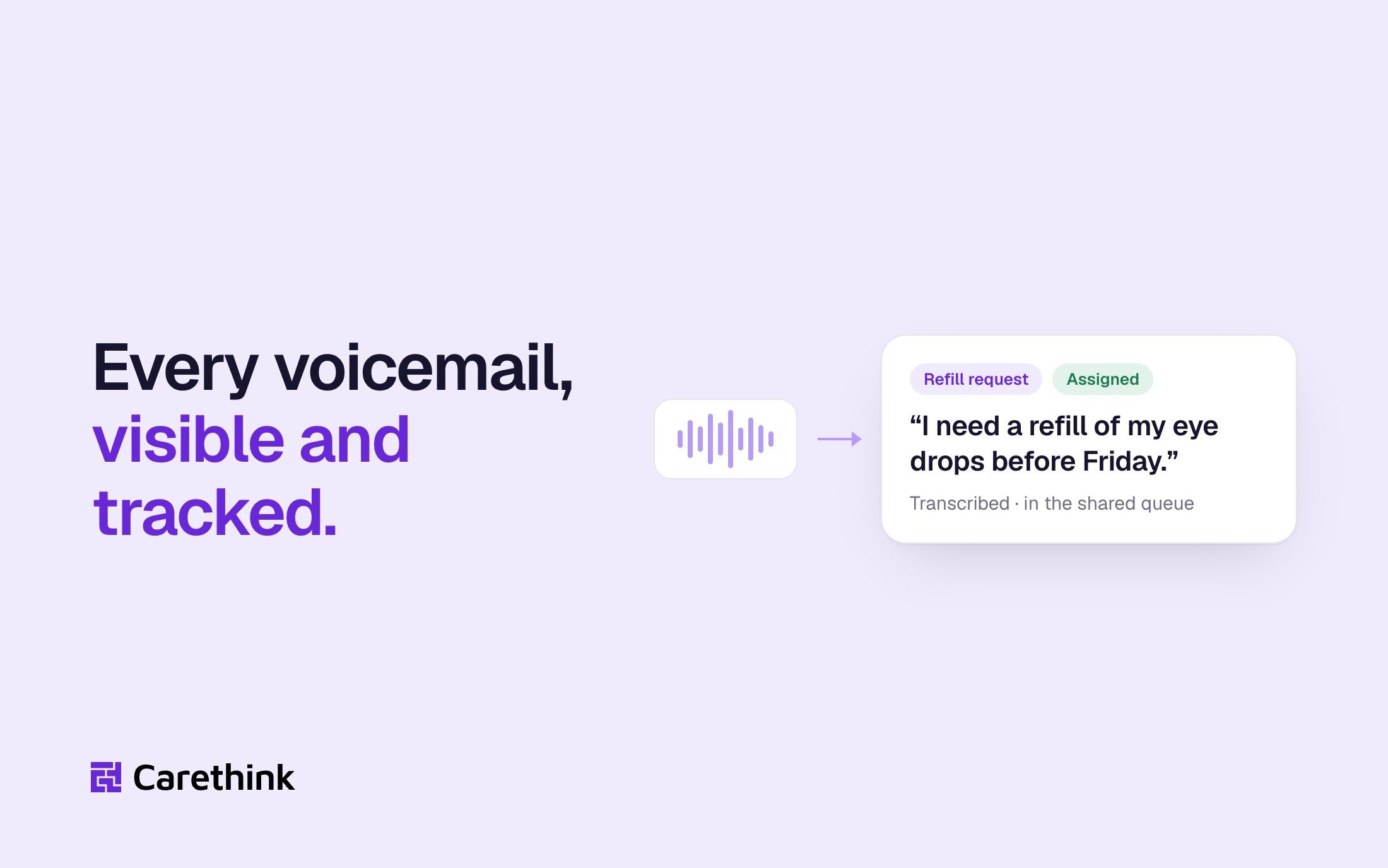
The first major change was bringing every voicemail into one centralized inbox. AI transcribed and summarized each message, then organized it into categories such as scheduling, billing, surgery, clinical questions, and prescription refills.
Messages that appeared urgent were flagged for staff review. Teams could work from shared queues, assign responsibility, record callback attempts, leave notes for colleagues, and track each request through completion.
We also implemented multilingual transcription across 10 languages. Patients can leave messages in any of those languages, and the system transcribes and translates them into English so staff can review, route, and respond to each request through the same centralized workflow.
This created an operational closed loop: the practice could track each message from receipt through review, follow-up, and completion. AHRQ’s closed-loop communication guidance similarly emphasizes confirming that a message has been received, although the practice’s workflow extended that principle by also tracking action and resolution.
The new visibility also changed the call flow
After the centralized voicemail process was implemented, the practice shortened the time before voicemail from approximately 10 rings to three.
Previously, sending callers to voicemail sooner created concern that the practice might miss opportunities to answer calls. With the new system, a voicemail no longer disappeared into an individual employee’s phone. It entered a visible queue where it could be prioritized, assigned, and tracked.
The shorter ring time therefore became part of a broader operational redesign. Patients could leave their requests sooner, while the practice retained visibility and control over what happened next.
How the new process helped the practice
The most immediate improvement came from making audio readable. Employees previously spent as long as five minutes handling some refill requests because they needed to listen carefully, replay details, and extract the information required for follow-up.
With a transcript and structured summary, staff could scan the request and begin working much sooner. Across thousands of voicemails, the time required to process an individual message fell by almost sevenfold.
Centralization also reduced dependence on particular employees. Several schedulers could work from the same queue, while surgical and clinical messages could be routed to the appropriate teams. If a patient did not answer a callback, the employee could record the attempt and leave the request open for follow-up.
Managers gained visibility into message volume, categories, ownership, response times, and completion. They could identify backlogs, prioritize urgent requests, distribute work across employees, and see how reliably the organization was responding to patients.
That visibility affects more than administrative efficiency. The AHRQ Clinician & Group Survey includes timely access to care and information among its core patient-experience measures.
The broader lesson
The practice needed visibility into a patient-facing process that had previously depended on individual phones and individual follow-through.
Once the practice could see the work, it could manage the work. Voicemails were processed faster, teams could collaborate, urgent messages received attention sooner, and leaders could understand how well patients were being served.
FAQs
What is voicemail management?
Voicemail management is the centralized capture, transcription, routing, assignment, and tracking of patient voice messages through completion.
How does centralized voicemail management help a healthcare practice?
It gives teams a shared view of incoming requests, reduces dependence on individual employees, improves prioritization, and allows managers to track response times and completion.
Can an AI answering service replace traditional voicemail?
It can be useful when the practice needs to collect specific information through follow-up questions. Whether a request begins through voicemail or an AI answering service, it should enter the same centralized and trackable workflow.
Sources used
- AHRQ: CAHPS Clinician & Group Survey
- AHRQ: Closed-Loop Communication
- Carethink operational data from an ophthalmology practice; customer identity withheld.
About the author

Joseph Pipia is a healthcare technology entrepreneur and product builder. He has built and scaled health tech products used by large hospitals and ambulatory centers, supporting care for millions of patients. He earned his MBA from MIT Sloan School of Management.
Joseph Pipia on LinkedIn